


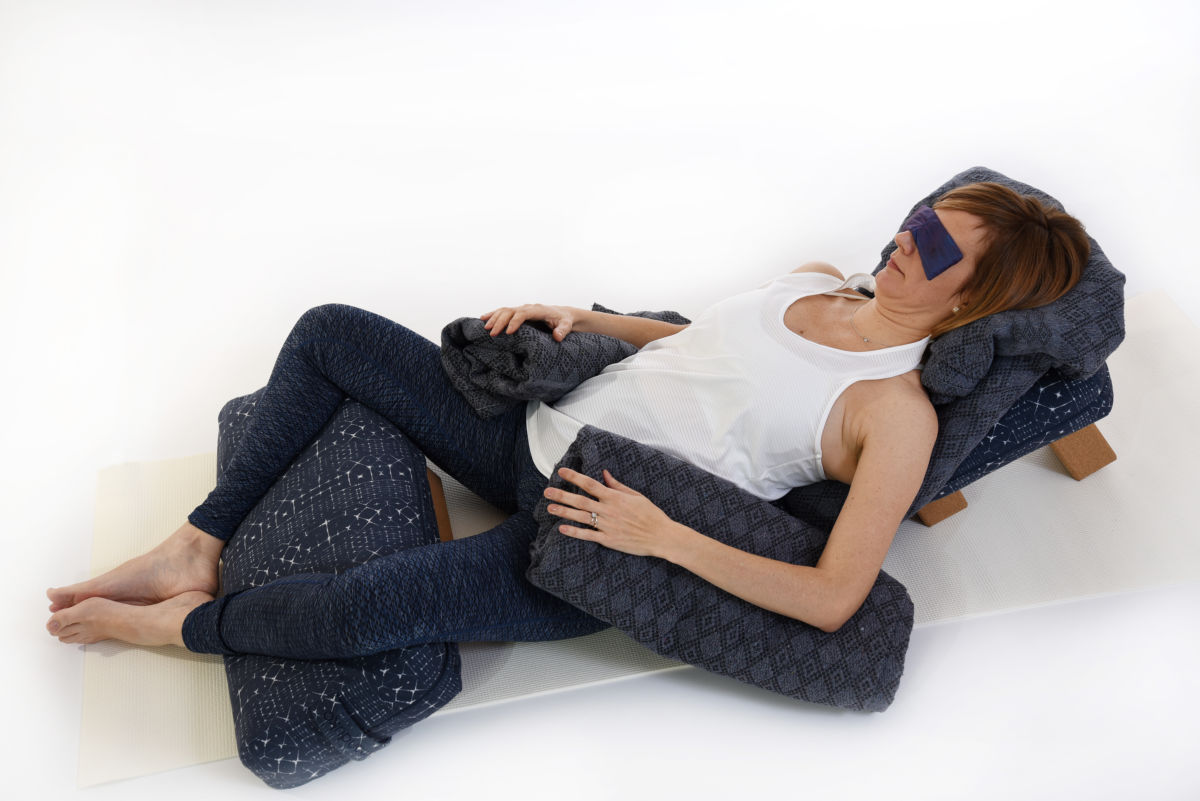
Yin vs. Restorative Yoga in short: Restorative Yoga focuses on deep relaxation and renewal, where Yin Yoga works by stretching the tissues. Poses are held for 5 to 20 minutes with plenty of support (bolster, blankets, blocks, eye pillow) to regulate the nervous system, stimulate digestion and the immune system, and help regulate inflammation. Complete comfort, silence, and a quiet setting encourage letting go and overall well-being.
The question of Yin vs. Restorative Yoga comes up often, because Yin and Restorative Yoga are both gentle practices. Their aims are different.
Yin vs. Restorative Yoga at a Glance
| Yin Yoga | Restorative Yoga | |
|---|---|---|
| Aim | Works on the connective tissues, to lubricate the joints and gain flexibility | Regulates the nervous system, for deep relaxation and renewal |
| Stretching | An element of stretching, to place stress on the fascia | None, because stretching would stimulate the nervous system |
| Sensation | Mild discomfort | Complete comfort |
| Props | Few | Many: bolster, blankets, blocks, strap, eye pillow |
| Time in each pose | About five minutes | Five to twenty minutes |
| Setting | Can include music | Quiet, warm, softly lit, with as little sensory stimulation as possible |
Two Different Aims
Yin Yoga focuses on the connective tissues, so it includes an element of stretching to place stress on the fascia. It is recommended for lubricating the joints and gaining flexibility. In Restorative Yoga, we avoid stretching because it would stimulate the nervous system. We want to open the different areas and organs of the body to improve blood circulation and “nourish” the whole system while we rest deeply. The goal of Restorative Yoga is to regulate the nervous system, allowing us to move from sympathetic dominance (the fight-or-flight response) to parasympathetic dominance (the rest-and-digest response).
Digesting More Than Our Food
We need to digest more than the food we eat. Every sensory impression we come into contact with, everything we see, hear, and feel, has to go through this process too. We absorb what nourishes us and release the tensions that limit our well-being. Beyond helping us become more emotionally resilient, Restorative Yoga stimulates our digestion, our immune system, and our fertility.
What Research Says About Restorative Yoga
In a 2010 study, Janice Kiecolt-Glaser and her colleagues compared 50 healthy women, 25 novices and 25 experienced yoga practitioners, before, during, and after a Restorative Yoga session. The session improved their sense of well-being, with no significant difference in their inflammatory or endocrine responses. The differences appeared between the two groups: the novices’ serum levels of interleukin-6, a pro-inflammatory molecule, were 41 percent higher than those of the experienced practitioners, and C-reactive protein was 4.75 times more likely to be detectable in a novice. These results suggest that regular practice may help us regulate stress and inflammation.
Restorative Yoga also shows promise for perimenopause and menopause. In a 2006 pilot study at the University of California, San Francisco, using a program designed by Judith Hanson Lasater and Suza Francina, 14 menopausal women with no previous yoga experience practiced eight restorative poses over eight weekly classes. Their average number of weekly hot flashes dropped by 30.8 percent, and their hot flash score by 34.2 percent. The study had no control group, so larger trials are needed to confirm these early results.
A randomized pilot study of 44 women with breast cancer points to other potential benefits: after ten weekly Restorative Yoga sessions, the women reported more positive emotions and less depression than the waitlist group, and their fatigue improved.
Comfort and Props
In Yin Yoga, the aim is to find inner peace quickly in positions that involve mild discomfort. Few props are used. In Restorative Yoga, we seek complete comfort, so that the body has no choice but to relax and let go. Each pose uses many props (at least one bolster, three blankets, two blocks, a strap, and an eye pillow) to support us in relaxing, to “nourish” us, and to calm us.
Why Props Protect Your Ligaments
Using many props has another advantage: it avoids stretching the ligaments that give us the stability we need. For example, if we do not support our thighs enough in Supta Baddha Konasana, a pose practiced in both Restorative and Yin Yoga classes, the anterior sacroiliac ligaments will be stretched. Their role is to stabilize the sacroiliac joints so that we can walk, and it is essential not to stretch them. This matters even more at the end of the menstrual cycle and during pregnancy, because higher levels of relaxin loosen all the tissues in the body, including the ligaments. Regularly going beyond your range of motion at these times could create joint instability and long-term pain.
We seek complete comfort, so that the body has no choice but to relax and let go.
Timing and Setting
Another important difference is timing. In Yin Yoga, poses are held for about five minutes. In Restorative Yoga, we generally stay in each pose for five to twenty minutes in order to regulate the nervous system. This first stage of physiological relaxation may take about fifteen minutes, depending on our ability to let go.
Yin Yoga can be practiced with music. In Restorative Yoga, we reduce sensory stimulation as much as possible, because it activates the fight-or-flight function of the nervous system. We practice in a quiet, warm, softly lit place to inhibit the reticular activating system (RAS) and activate the relaxation reflex.
Ambition has no place, and the satisfaction comes from receiving the pose rather than doing it.
Renewal Rather Than Flexibility
In short, Restorative Yoga is a practice of renewal, with no aim of increasing flexibility. Its purpose is to relax deeply and move toward a state of pratyahara, where ambition has no place and the satisfaction comes from receiving the pose rather than doing it. Restorative Yoga is suitable for everyone. There is nothing that relaxation does not help.
Supta Baddha Konasana, Restorative Version: 20 Minutes
You will need: a mat, two to three blocks, two bolsters, five blankets, and an eye pillow.

Photo credit: Carlo Cattadori
Setup:
- Start by placing a bolster lengthwise on your mat, on two blocks, tilted slightly forward. The block at the top of the bolster stands upright, and the block at the middle of the bolster lies flat.
- Cover the bolster and the floor with a blanket folded twice widthwise, for more comfort along your back.
- At the top of the bolster, add a standard blanket folded into two levels: the higher one supports your head and your seventh cervical vertebra, and the lower one supports your shoulders.
- Sit in front of the bolster with your legs straight out in front of you, then lie back on the bolster. Leave no space between your pelvis and the bolster, so that your lower back is well supported.
- Bend your knees and bring the soles of your feet together, with your knees out to the sides of your mat in butterfly position. Slide a second bolster under your knees. If you have a rectangular bolster, place a block under it. Your knees will rest on the edge of the bolster. Keep in mind that your inner thighs should be relaxed and free of any stretch. Support your thighs enough to avoid stretching the anterior sacroiliac ligaments.
- Roll the edges of the blanket along your neck and head and under your shoulders, so that you feel supported.
- Rest your relaxed hands on your belly, and support your elbows and arms with two rolled blankets on either side of your torso.
- Cover yourself, place an eye pillow over your eyes, and relax for twenty minutes in silence.
Is Yin the Same as Restorative Yoga?
No. Both are gentle practices with long holds, which is why they are often confused. Yin Yoga includes an element of stretching to work on the connective tissues, and it uses few props. Restorative Yoga avoids stretching and uses many props, so that the body can rest in complete comfort and the nervous system can regulate itself.
Is Yin or Restorative Yoga Better?
Neither is better in itself, because they serve different purposes. It depends on your needs and your goal. Choose Yin Yoga if you want to lubricate your joints and gain flexibility. Choose Restorative Yoga if you need deep rest and want to regulate your nervous system.
Would you like to go further in your practice or your teaching?
Start with my free course for yoga teachers, Bring Restorative Yoga into Your Teaching. You will learn how supported rest can enrich your teaching, then experience it yourself through a guided Restorative Yoga practice.
Sign up for the Slow Down & Restore newsletter to receive the course.
When you join the newsletter you receive the free course Bring Restorative Yoga into Your Teaching, then a series of welcome emails and, after that, about two emails a month. You can update your details or unsubscribe at any time using the link at the bottom of every email, or by writing to me at info@restorativeyoga.org. For more information, see my privacy policy. By signing up, you consent to the processing of your data as described above.
I use Kit as my email platform. By signing up, you agree that your information will be transferred to Kit for processing.
To practice with me, join my online classes. You can also explore my Restorative Yoga teacher training, or read Yoga Nidra vs. Restorative Yoga.

Audrey Favreau has trained Restorative Yoga teachers since 2015 and is one of three teachers designated by Judith Hanson Lasater to certify in the Relax and Renew® lineage, alongside Judith and Lizzie Lasater, who certify directly.